

When development feels like being sent away to be fixed Some of the work I’m involved in is...
Good intentions, wrong impact
I’m seeing a pattern. Organisations are trying to improve psychological safety, and accidentally feeding the very thing they’re trying to fix.
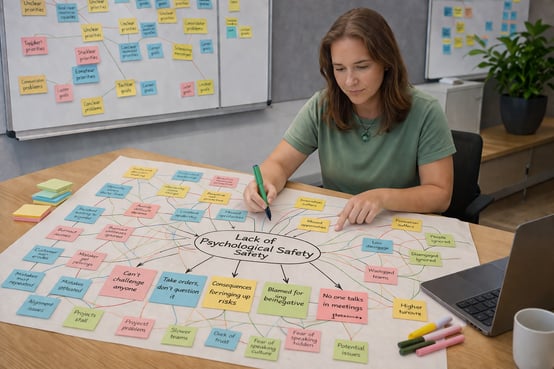
Boards and senior leaders are made aware that psychological safety is an organisation-wide issue. They want to understand it, fix it and get closer to it.
It can unfold like this:
- Senior leaders are debriefed on the culture signals coming through from employee feedback.
- One of those signals is a lack of psychological safety.
- The process continues through team debriefs and conversations with team leaders, so the organisation can understand what sits beneath that result.
- Some senior leaders—and sometimes HR—decide they need to be in the room. They want to know what people will say and retain some control over how the conversation plays out.
- People become more guarded. They filter what they say and are careful about how they say it.
The real reasons people don’t feel safe speaking up never surface.
When stepping back does more than stepping in
In sessions where leaders step out of the room, the conversation often flows more freely. People are more open, more honest and far more specific about what’s actually getting in the way.
That’s where the real context sits.
It changes the role of leadership. It becomes less about being present in every conversation and more about creating the conditions in which honest conversations can happen.
That means stepping back at the right time. Letting people speak openly without feeling watched or managed. Trusting that what surfaces in those spaces is exactly what needs to be heard—even when it’s uncomfortable.
Frustration can be part of the process
People need space to air their frustrations. To say the thing that’s been sitting there for a while. To feel heard without someone jumping in to fix it, explain it or defend it.
That isn’t unproductive. It’s part of the process.
Once people can get that out, they often think more clearly about what needs to change. The conversation moves from reaction to reflection, and that’s where better ideas start to emerge.
Then leaders step back in, not to control the conversation, but to respond to it. To show people they’ve been heard and that something will be done with what they’ve shared.
Respond...don’t monitor
If you’re serious about improving psychological safety, one of the simplest steps may be not attending the first round of conversations.
Receive the themes afterwards. Then step in to respond, rather than monitor.
Psychological safety isn’t created by leaders hearing every word in real time. It grows when people can speak honestly, trust the process and see leaders respond constructively to what has been heard.
That’s how you stop feeding the control monster.
Seeing something similar in your organisation?
Explore how Culture Movers connects leadership and culture without suffocating the conversation.
Want a regular view of the patterns we’re seeing?
Join Culture Kōrero, my monthly newsletter where I share insights from the conversations I’m having and the patterns emerging across workplaces.